 Congratulations! You've finally mustered enough creativity and patience to finish your piece of writing. The hardest part is over, and now all you need to do is review the entire piece for grammatical and spelling errors.
Sounds easy, right? Be careful, though. If you do not do this last step carefully, you might jeopardize the high rating your excellent article deserves because of minor, “stupid” grammar and spelling mistakes. That is not a good way to reward your hard work.
Proofreading, the process of carefully examining a text for errors, is a task often done hurriedly and unenthusiastically by tired editors or impatient writers. When done without much care, the whole process consists of scanning the entire text without really zeroing in on errors individually. This is an understandable tendency for someone who has spent long, draining hours trying to finish a well-written piece and is too tired to check for minor errors.
How, then, do you go through the process of proofreading in an efficient and effective way in the shortest possible time? Here are five very practical tips you can use the next time you need to proofread an entire text:
1. Increase the Font Size
Nothing strains tired eyes more than reviewing a long text in a tiny font size. For the sake of this final step in your writing process, highlight everything and select a font size that is larger than usual. This will help you throughout the entire proofreading process.
2. Read Everything Aloud
This may sound as though it will take time, but it is actually one of the quickest ways to check for awkward sentences, run-on sentences (info), parallelism errors (info), word choice mistakes, sentence clarity (info), and the overall voice of the article. It may come as a surprise just how many errors you can spot and correct when you read a text aloud compared with when you simply scan everything with your eyes. Remember, your eyes are tired at this point. This time around, make use of your ears to “listen” for mistakes. It works wonders.
3. Then, Silently Read the Entire Text Backward to Check for Spelling Errors
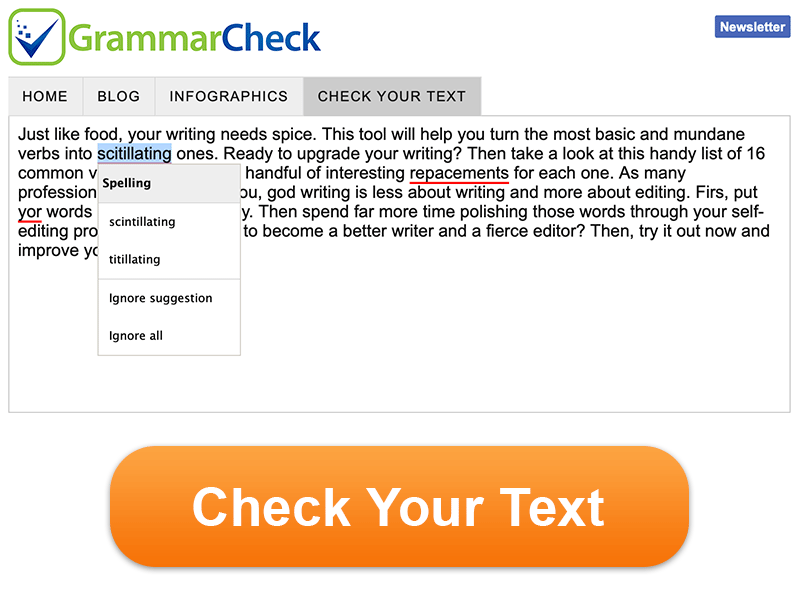
The mind actually works twice as hard to analyze every word when you read sentences backward. This is a reliable way to check for spelling errors. However, not everyone has the time to do this, so a good spell checker can be of great help in this phase of your proofreading. Our spell checker can be used for free and may also give you suggestions on how to improve the grammar of the piece.
4. Read Everything Again, but This Time, Use a Blank Sheet of Paper to Cover the Parts of the Text Below the Sentence You Are Currently Reading
This technique is pure genius; it tricks the mind into not being overwhelmed by the rest of the paragraphs it has to edit. By exposing only the sentence you are reading and proofreading, you essentially lead your brain into thinking that it only has that one line to edit at that particular time. A tired mind that is not overwhelmed works a lot more efficiently than a tired mind that is aware of the bulk of tasks it still has to finish. Also, check out this guide by the UNC Writing Center.
And while we're on the topic of tricking your mind, go ahead and listen to feel-good music as you go along. Let's admit it: proofreading is a very boring job, and even though it doesn't require much creativity, it does require intense focus. A little music in the background may help lift some of the pressure from your brain while still letting you proofread with focus.
5. If You Have More Time to Spare, You May Want to Try the Following:
a. Finish your piece the night before, and then get up early in the morning to proofread your work. A freshly recharged mind is a very sharp proofreading tool.
b. To make your proofreading tasks easier in the future, make a checklist of the most common errors that you tend to make in writing. If you have a tendency to mix up prepositions, note that down and be more mindful of it the next time you edit another piece. If you find yourself writing dangling modifiers, note that down as well. Do this for any grammar or spelling error that seems to recur in your writing. The next time you need to proofread an article, you can use the search function in your word processor and type in these common errors to make your proofreading more systematic and efficient. Read more about common grammar errors here.
c. Print out your piece and edit it on paper. This particular tip works if you really have to focus on the content and the flow of ideas in your text, rather than only on grammar and spelling. Printing your work and going out to a garden or a relaxing spot with your editing pen is a good way to check the logical flow of ideas in your text. This way, you can scribble corrections and new paragraphs in the margins of the printouts.
d. If you really have a lot of time, read your work once for each type of grammar or spelling error. For instance, you may want to focus on parallelism during your first reading, then run-on sentences during your second reading, and so on. This is a very meticulous way of proofreading, but it is one that helps produce the best results. Your work will surely be stronger after you use this technique.
Whether you need to proofread within minutes or over several days, this process of checking your written work is a step that should not be taken for granted. You can find more proofreading advice from Purdue OWL here.
Unfortunately, all it takes for a professor or magazine editor to reject your work is a recurring error or a poorly constructed sentence. So even if you have genius ideas in there, your work may still get rejected. Do not allow this simple mistake to jeopardize your chance of getting published or getting a high grade. Use the right proofreading techniques, whether you do it the fast way or the slow, very detailed way.
For dictionary support while proofreading, you can also use Oxford Learner’s Dictionaries, a trusted resource for definitions, examples, synonyms, and pronunciation guidance.