 In a nutshell, proofreading refers to the process of checking text to detect and correct spelling errors, typos, and other mistakes that may have occurred during the writing process. Proofreading should be performed before content is posted online, and it can be done either manually or with the help of various online tools. The latter choice is common because online proofreaders are fast and convenient. Here you will find 10 essential proofreading tips that will help you polish a text before uploading it or submitting it elsewhere:
1. Focus on Punctuation!
Paying attention to punctuation is extremely important when it comes to proofreading your text. After all, this involves more than looking for errors: you need to see whether the phrases are properly connected to each other and whether they make sense. Sometimes, if you misplace or forget to use a comma, you can change the whole meaning of a phrase. Avoid using too many question marks and exclamation points. More about this here.
2. Take a Break Before Proofreading the Text
Once you are done writing your text, take a break of 10 to 15 minutes before you move on to the next step. If you are not on a tight schedule, leave the text for a couple of days and return to it with fresh eyes. If you take a short break, it will be easier for you to spot mistakes that may have occurred. Some phrases or syntagms (Definition) may not sound right, and you will have to replace or correct them.
3. Ask Somebody to Proofread It for You!
This is certainly a great idea. If you ask a friend to proofread your text for you, they will read it from a totally different perspective, an objective one. You may be amazed to see how many errors you missed. Usually, this does not happen because of ignorance, but simply because you were tired or not paying close enough attention.
4. Make Use of Online Tools
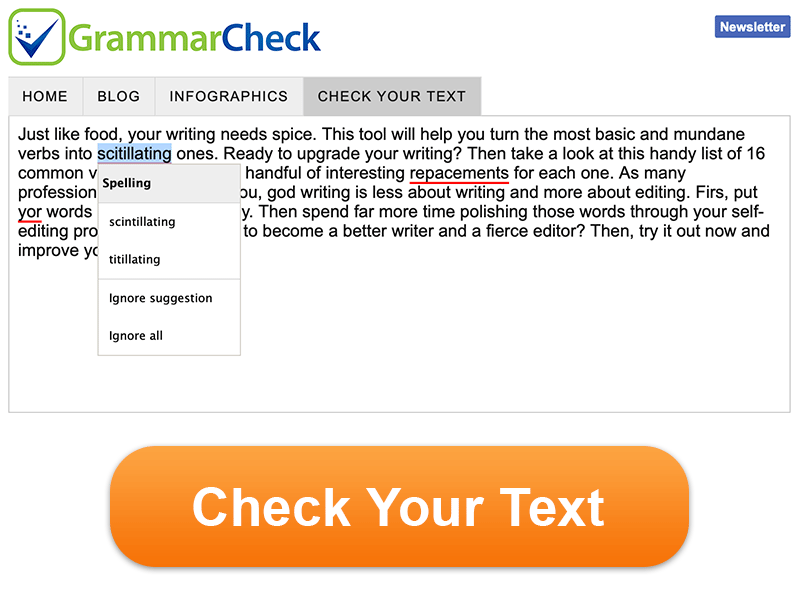
Fortunately, you can find many free online tools that will check your text for errors. They are quick and efficient, which is why they are of great help to writers, bloggers, and journalists. These online spell checkers can easily detect repeated words, and they can inform you if you have forgotten or reversed letters. These online tools are ideal for writers who are always in a hurry and who want to check their content one more time, just to make sure it is polished.
Our online editor provides free, online proofreading of your texts, and it doesn't require any download whatsoever. The "Deep Check" button can detect up to 10 times more mistakes than regular word processors. It also comes with writing suggestions that aim to help you improve your writing skills. All you have to do is copy and paste the text inside the designated box and click the "Free Check" button. It is simple and easy.
In addition to being a useful online proofreader, it also comes with other features, such as vocabulary suggestions. The tool will suggest words that are likely to be more suitable for your text. Besides, this free online proofreader also allows you to check your text against online documents to help prevent plagiarism.
5. Read It Out Loud
Reading your text out loud is a great way to identify possible mistakes. Maybe something does not sound right: perhaps you have not used the most suitable verb, or perhaps you have missed a word. Reading your text out loud is certainly one of the best ways to identify mistakes and correct them, since you will have to read every word. This significantly increases your chances of finding a typo. If you haven't been able to see your mistakes, maybe you will be able to hear them!
6. Proofread the Printed Version of Your Text
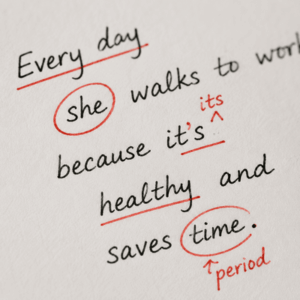
If you spend a lot of time in front of the computer, your eyes will eventually become tired, and you may no longer be able to spot typos and spelling errors. This is why it is highly recommended that you print your work and proofread the printed version rather than the digital version. Use a pencil to underline and correct your mistakes on the piece of paper, then move on and correct them in the digital version. This Purdue OWL guide is also useful in this regard.
7. Split the Text Into Pieces
If the text you are trying to proofread is too large or has too many numbers, headers, and bullet points, try to split it up and correct one part at a time. For instance, you can correct the introduction, the paragraphs in the main body, and the conclusion. After you are done, you can correct the subheadings to see whether they are accurate and relevant. Leave numbers and bullet points until last, and focus first on the main text.
8. Pay Attention to Details
Details are what truly make the difference! Proofreading does not refer solely to checking your main text; it also refers to checking image names, references, tables, and similar elements. Check for errors in numbers and symbols as well (CIEP guide).
9. Take Your Time!
If you have a busy schedule and cannot afford to waste time, then it is highly recommended that you read the text carefully the first time you do it. This is much more efficient than going through the entire text twice without focus. Go through every word, sentence, and paragraph. Do it slowly but surely.
10. Pay Extra Attention to Names and Numbers
Last but not least, one of the most important proofreading tips is to pay extra attention to names and numbers. Names and numbers are important, and you must write them correctly. Unfortunately, no spell checker can reliably correct them for you, so you will have to do it yourself. Pay attention to foreign names and double-check numbers, especially long ones. More information is available here.
To sum up, these are 10 simple and effective proofreading tips you should take into account after writing a text. They can help you identify and correct errors in a fast, efficient manner without having to go through the entire text several times.