 Many people misspell common words, confuse similarly spelled words, or simply use the wrong form of words like "there" and "their." In a family, friendly, or informal setting, it doesn't matter as much when such words are misused or confused, since we usually know what the writer intends to say. In a formal or business setting, however, such mistakes can be quite expensive. Grammar errors that make you look unprofessional can cost you customers or even indirectly drive you out of business.
Here are the most common mistakes. If you can avoid these mistakes in your business and website materials, you will stand out to potential new customers:
- Subject/verb agreement: Many people know the basics of this rule. The concept is to match a plural verb with a plural noun and a singular verb with a singular noun. You would, for example, say "The lady is speeding" and not "The lady are speeding." Some people also get mixed up with subjects such as "nobody" or "everyone." These words can be confusing because they refer to people in a general sense, but they are grammatically singular. So you would say "Everyone has an important issue" or "Nobody wants to be wasted," not "Nobody want..." or "Everyone have..."
- Mixing up the past and present tenses: This is a common error in fiction writing, but it also appears once in a while in business correspondence. In some cases, service or product descriptions are written in the present tense to create a sense of urgency or immediacy. The error that occurs in such instances, however, is the failure to maintain the present tense. The only exception is when you clearly state that you are talking about an event or situation in the past. For example: "Even ten years ago, older people weren't able to get news in time."
- Apostrophe errors: Apostrophes are usually used for two reasons: to show that letters have been removed from contractions, as in "won't" instead of "will not," or to express possession, as in "A toy is the boy's best present." However, it is a common grammatical mistake nowadays for people to misuse apostrophes to form plurals. Do not write "Only dog's should eat dog food." Instead, write "Only dogs should eat dog food."
- Failure to put the proper ending on a past-tense verb: You are probably well aware that many past-tense verbs end with -ed: picked, stated, walked, and so on. There are exceptions, however, and it is easy to make mistakes. Be sure to check your correspondence carefully, or better still, have someone proofread your work before presentation. Sentences such as "Yesterday, he walk to that hotel" sound uneducated. They are easy to catch and fix, so make sure you review your work carefully.
- Misuse of commas: Commas are often used to indicate a pause or to separate parts of a sentence. A common mistake is using them in place of periods or semicolons. If the second part of the sentence can stand on its own as a complete sentence, then you may need a semicolon, a conjunction, or a full stop.
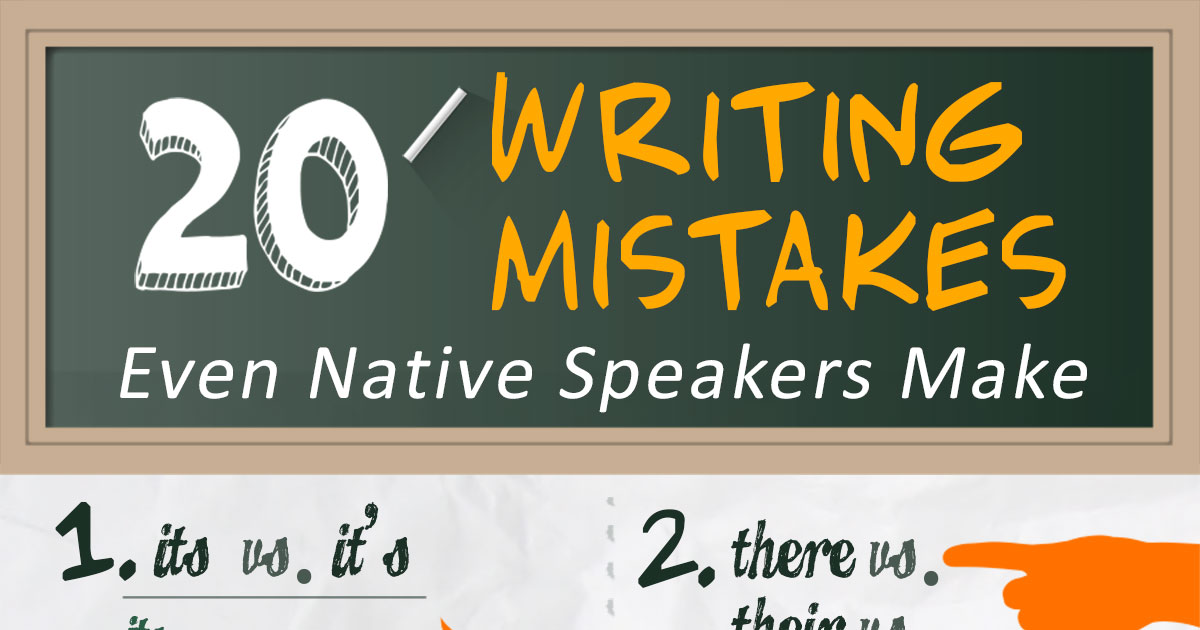
- Use of the wrong form of "there": Many people confuse the words "there," "their," and "they're" because they sound alike. There usually refers to a place or introduces a statement. Their indicates possession. They're is a contraction of "they are."
- Then and than: Than is used for comparison, while then is used to refer to something happening next or at that time.
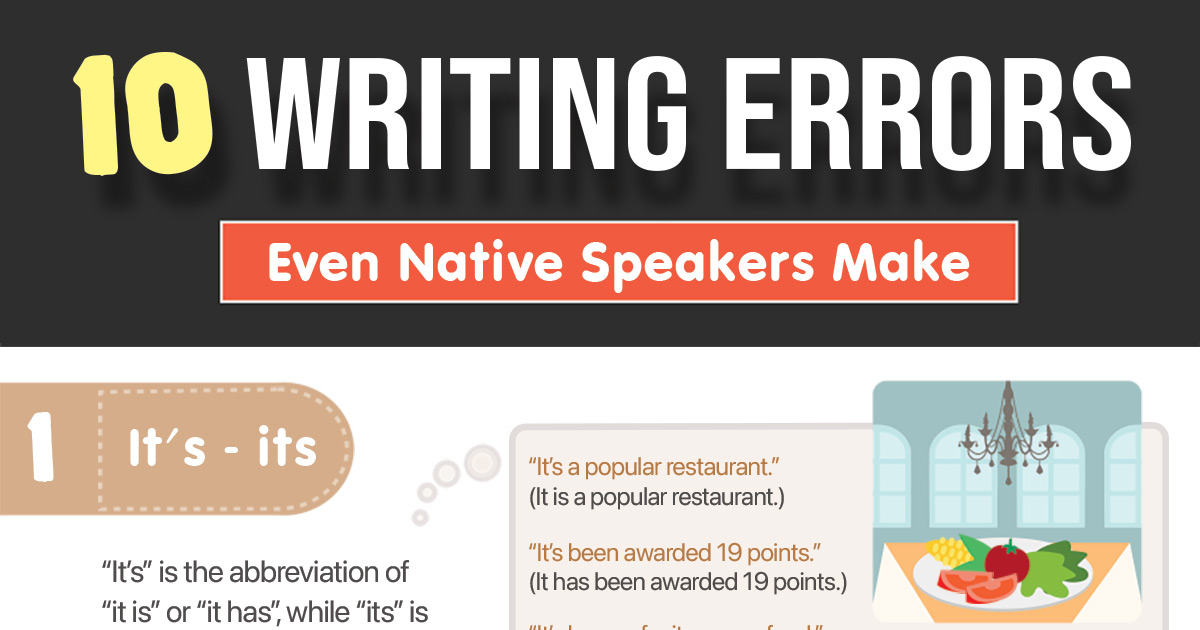
- Confusion of "it's" and "its": This is one of the most common typos in everyday writing, especially in descriptive writing. Its does not follow the usual apostrophe rule for possession. The apostrophe is used only when contracting "it is" or "it has." So write "Your phone has lost its value" instead of "Your phone has lost it's value."
- Lose and loose: That probably caught your attention, right? This mistake is quite common among casual or informal writers. Loose is an adjective that means not fastened, not tight, or not confined, while lose means to no longer have something, to fail to find something, or to fail to win.
- Misplaced modifiers: To ensure that your ideas are communicated clearly, you need to place a modifier directly next to the word you intend to modify. The modifier needs to refer to a specific word in a phrase or sentence. Instead of writing "At ten years old, my mother gave me a toy for Christmas," write "When I was ten years old, my mother gave me a toy for Christmas."
- Fewer and less: Less is used when referring to uncountable quantities. Fewer is used when referring to countable things. For example: "The school has fewer than twenty employees" or "The school is less successful this year."
- Which and that: This is understandably one of the most common grammar errors out there. You need to keep in mind that that is restrictive and is essential to the noun it refers to. For example: "I don't trust software that has no user manual." In this case, I am referring specifically to software without a user manual. Which is often used to introduce a nonessential clause. For example: "I recommend that you buy certified software, which is available from certified stores." In this case, the clause adds extra information. Just remember that that restricts, while which often adds information.
The best practice for avoiding these common typos and grammatical mistakes is to identify your weaknesses first. Point out the areas that trouble you and practice until you have clearly singled them out and mastered them. Here is another useful checklist.
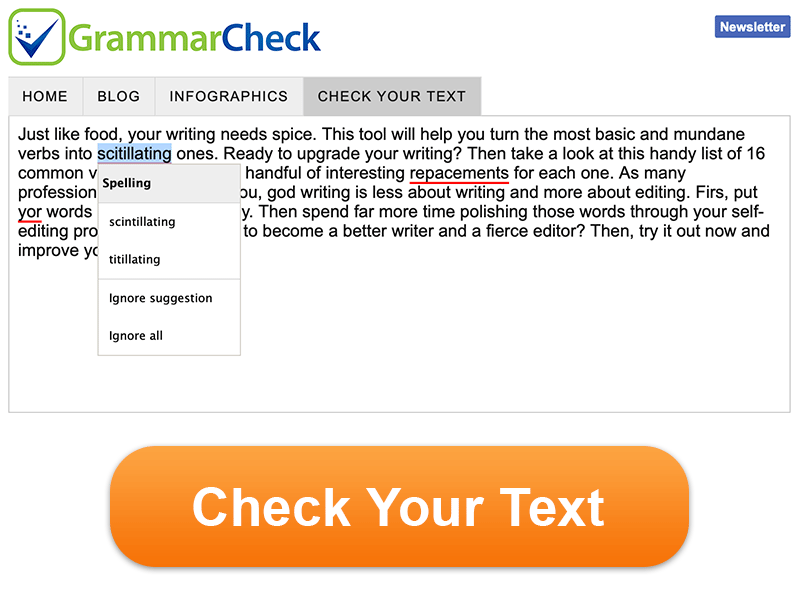
You need to keep in mind that this takes time and cannot be accomplished in a single sitting. It improves through your daily writing and speaking. Our spell checker here offers aid in the form of instant spell checking, which can make your learning a lot easier.
Keep practicing and do not neglect the little things. Remember, they are the ones that matter here. Bottom line: practice makes perfect.