Why care about grammar? Some of the greatest works and catchiest phrases use awful grammar. Whoever wrote “Here’s looking at you, kid” would have failed English, and “I can has cheezburger” is utterly beyond hope. “Goodbye and good luck!” and “Can I have a cheeseburger?” would be far better grammar, yet far less effective. Unfortunately, simply ignoring grammar rules will never make your writing as catchy as Gone with the Wind or an Internet meme. The reason those phrases work is that they were written by people who didn’t break rules until they knew why those rules existed. If you write without knowing the rules, you come across as someone who is poorly educated and not especially smart.
Grammar provides a common and widely understood structure for language. It is a set of rules that, if followed, produces text that any English speaker will understand and recognize as correct. Deviating from that structure without understanding what you’re doing produces text that fewer people will understand. In other words, it makes your message more likely to become garbled and less likely to be received at all. That doesn’t mean that grammatical structure is the best structure for every message, of course. It just means that it is the structure most likely to work.
Once you understand what grammatical structure looks like and why grammar rules apply, you can see where deviating from them will produce text that more effectively conveys the message you want. Hint: creative phrasing usually works best when it’s surrounded by proper English. Unfortunately, a lot of people make grammatical mistakes that simply get in the way of the message they want to send. These mistakes often reflect poorly on the writer, too.
Many common grammatical mistakes are simple and subtle, but subtle doesn’t mean they’re acceptable. Subtle mistakes still register in the lower reaches of your readers’ minds. They make readers take a little longer to understand the meaning of what you wrote, and they hurt your message. You want your message to come across as clearly as possible. Here are 10 common mistakes you should avoid.
1) Avoid putting commas in front of “that”
“He’s got a great landing page, that converts very well” is incorrect. You can put commas before which, but not before that. “He’s got a great landing page, which converts very well” is the correct phrasing if you feel the need for a comma. If that is more important to your conception of the sentence, phrase it this way: “He’s got a great landing page that converts very well.”
2) Stay away from sentences that start with the words “there are” or “there is”
Starting sentences like this is not necessarily bad grammar, but it is a frequent sign of lazy and ineffective writing, which can be just as bad. Instead of writing, “There are better ways to shovel snow in winter, like a snowblower,” write, “A snowblower is a better way to shovel snow.” This phrasing is simpler and more direct. A simple and direct phrasing may not be the tone you’re going for, of course. Now that you know the rule and the reason it exists, you can break it when it suits the situation, or follow it when following the rule is more effective.
3) Watch out for lists or bullet points that aren’t consistent
A classic example is starting out with a list of errors that people make and then, midway through, turning it into a list of things to do instead. Consider the following:
- Lots of people put commas before that.
- Starting sentences with “there are” is lazy.
- Make your bullet points consistent.
See the problem? The last point is not consistent with the first two. All of a sudden, it becomes unclear whether this is a list of things not to do or a list of things to do. This confusion hurts comprehension.
4) Never say you “could care less” when you mean you “couldn’t care less”
This mistake is particularly common among people with weaker English. To someone who is familiar with the phrase, this mistake conveys precisely the wrong meaning. In essence, you’re saying “do” when you mean “don’t.” It takes a second for readers to figure out what you actually meant, and making people take a second to understand your writing is not really something you want.
5) Never use comma splices; that’s a mistake
Consider this item’s title. It should not have been written, “Never use comma splices, that’s a mistake.” The problem here is that both sides of the sentence are independent clauses. A comma isn’t really strong enough to connect the two, so the mind has to jump the gap. Instead of making your readers take a leap, build them a bridge. If connecting the clauses with a word like “and” or “because” doesn’t fit, there are still options. You can make two sentences if you like keeping things short and to the point: “Never use comma splices. That’s a mistake.” There’s also the semicolon, the comma’s stronger brother: “Never use comma splices; that’s a mistake.”
6) Look out for “lie” and “lay” or “effect” and “affect” mix-ups
“Lie down” means to recline, while “lay down” means to put something down. Things get confusing when you start talking about the past. For example: “I lay in bed this morning, staring at the ceiling.”
“Effect” and “affect” are even trickier. Consider the following examples:
“That poem has a strong effect on people.”
“That poem really affected my view of the world.”
As a rule of thumb, affect is often a verb, while effect is often a noun.
There are exceptions, of course: “The program effected rapid change” and “That guy has a flat affect. Want to bet he’s a killer?”
7) Don’t mix up “which,” “that,” and “who”
“Which” is very general. It’s flexible and a little ambiguous. You can use it to introduce elements of a sentence that aren’t critical. “The trick to good writing is a lot of reading, which takes time.”
“That,” on the other hand, is restrictive and definite. When you use “that,” it carries weight. “A lot of reading is something that takes time.” If the subject of the sentence you’re writing is a person, use “who” instead. “John is a person who writes well because he reads a lot.” This one is subtle. A lot of people would make the mistake of using “person that writes” instead. Even if the mistake is common, it’s still a speed bump in your writing.
8) Avoid “or” when “nor” is what you need
Compare the following:
- “Neither one or the other could play hockey.”
- “Neither one nor the other could play hockey.”
See how the second one just feels better? It rolls past the eyes a little more easily. On the other hand, when we use “either,” we generally get it right. “Either one nor the other” is a mistake that almost everyone will spot. We recognize that the correct usage is “either one or the other.”
9) Don’t confuse “bringing” and “taking”
You might “bring something to the discussion,” but you wouldn’t “take something to the discussion.” On the other hand, we “take out the trash,” but we don’t “bring it out.” The difference is direction. We “bring the trash back in.” Bringing is moving something toward you. Taking is moving it away. “Chinese takeout” is, after all, when you move food out of the restaurant. That doesn’t mean you should call it “Chinese bring-in” once it shows up on your doorstep.
10) Watch out for misplaced and wrongly used apostrophes
First of all, if a plural word already ends in s, you don’t tack on a second s. If you mean multiple dogs, the word “dogs” keeps the s on the end. Otherwise, you would mean one dog. “The dogs houses were small but comfortable,” though, isn’t quite right. You need an apostrophe to show possession. The thing is, “the dog’s houses were” is still wrong if you mean houses belonging to several dogs. It would be right if there were multiple houses belonging to one dog. The solution is: “The dogs’ houses were small but comfortable.”
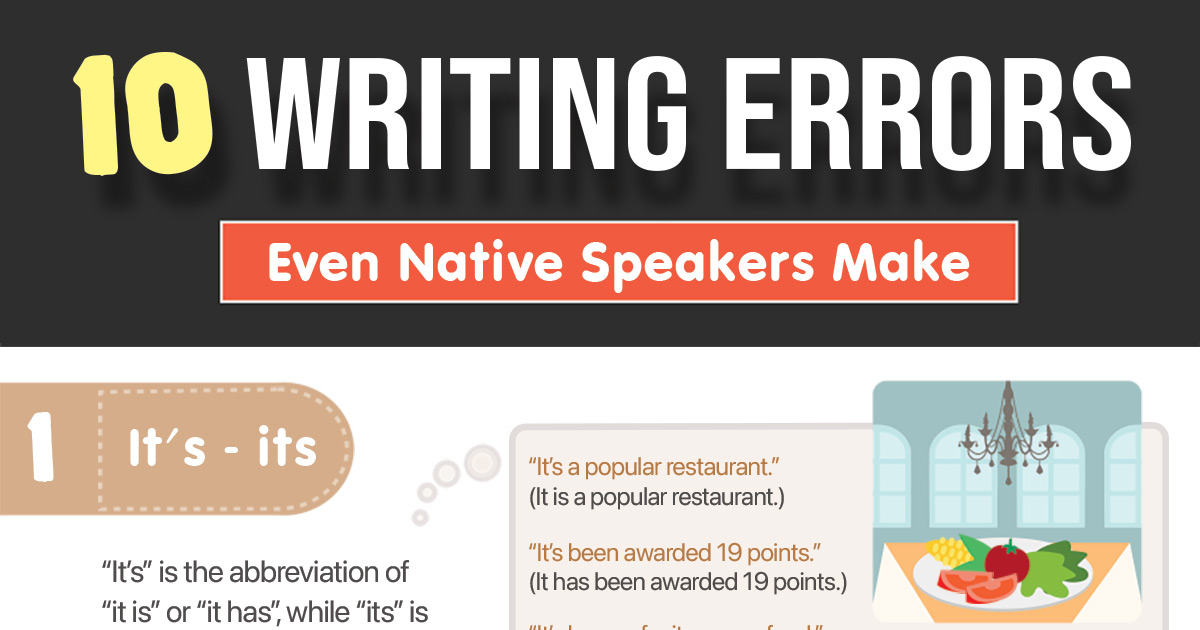
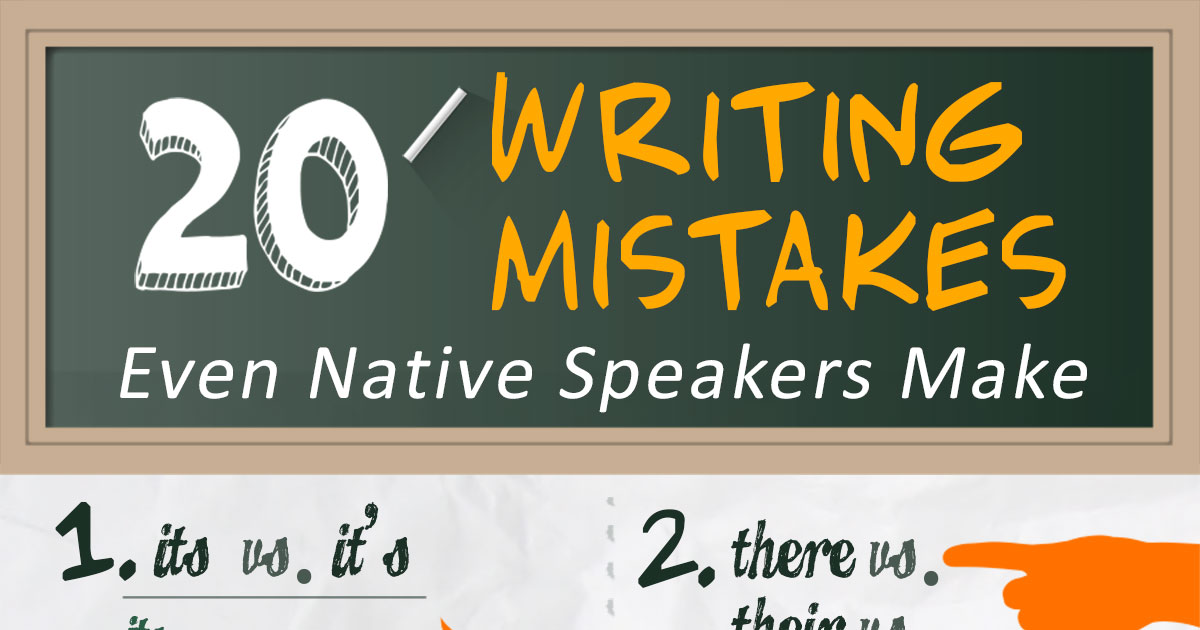
For more common grammar mistakes, have a look at our infographic here.