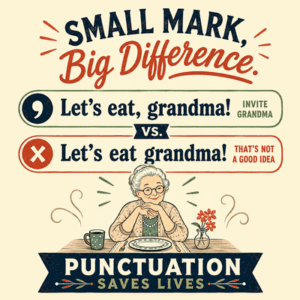
 Do you remember how hard your English teacher had to work to improve your English skills? Remember slaving over sentence structure, subjects, objects, and the correct use of grammar? Then you left school, and all of a sudden, the rules went out the window and text language became a lazy substitute for formal written communication. Without a doubt, at some stage in your adult life, you are going to need to write an application for a job, a mortgage, or a loan, and you may find that constant punctuation errors let you down. This article aims to address some of the most common punctuation errors and keep your English teacher happy.
1. Apostrophes in contractions
This is basic stuff. Any time you want to shorten a word in a contraction, you use an apostrophe. For example:
Do not = don’t
Is not = isn’t
Shall not = shan’t
The apostrophe must be placed where the letters have been removed.
2. Plurals vs. possession
Here’s one that would make your English teacher tear her hair out. You don’t make a noun plural by adding an apostrophe.
Buy my lovely fresh apple’s. Wrong, wrong, wrong!
Look at my lovely dog’s. No!
Putting an apostrophe after a noun often indicates possession, meaning that something belongs to someone or something else. For example:
Look at my lovely dog’s bowl. (One dog and one bowl to look at. The bowl belongs to the dog.)
The cat’s whiskers. (One cat with whiskers that belong to that cat.)
The apostrophe is placed after a plural noun when you need to show possession belonging to a group. For example:
The dogs’ bowls. (Many bowls belonging to many dogs.)
The footballers’ boots. (Many boots belonging to many footballers.)
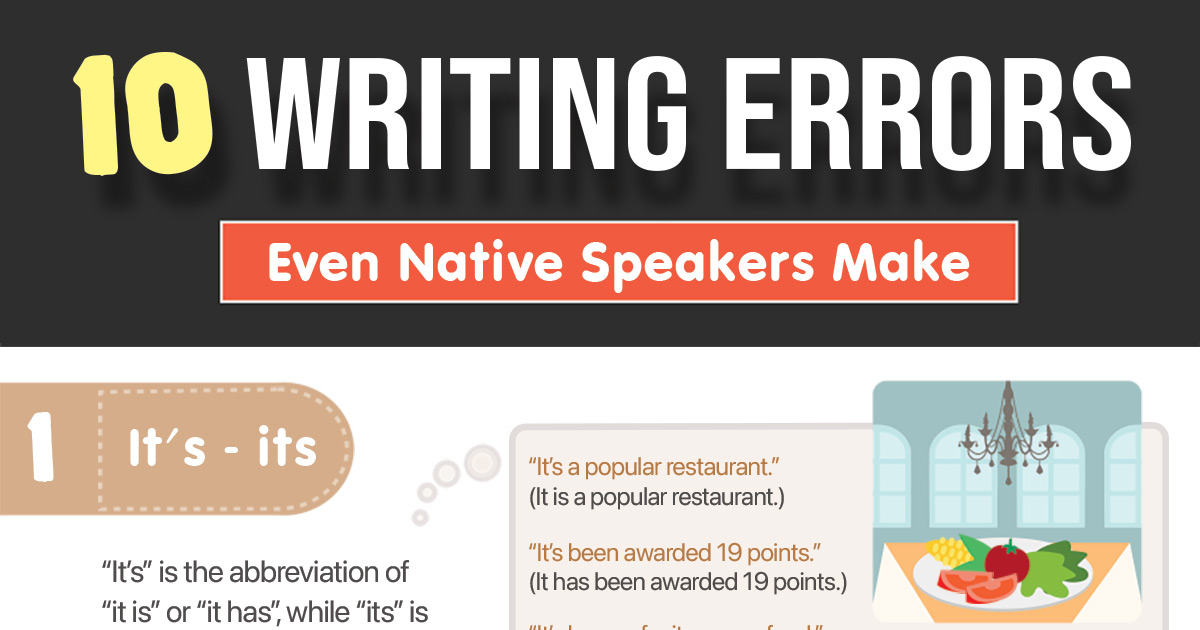
3. It’s/its
It’s = it is or it has. It is lovely. It’s lovely. This is a contraction. See (1) above.
Its = possession. Its eyes were green. This indicates possession.
Its’ = does not exist. Ever.
4. Your/You’re/You are
You are can be contracted to you’re. You’re the best.
Your demonstrates possession. Give me your car keys.
5. There/their/they’re
They are can be contracted to they’re. They’re such friendly people.
Their demonstrates possession. Give them back their passports.
There indicates place. I left my phone over there.
6. Arbitrary commas
Ah, the humble comma: a source of many punctuation errors. There are countless ways to use and abuse commas, but one of the most commonly confused uses is the comma that separates two complete thoughts linked with a conjunction. A conjunction, by the way, is the glue that joins two or more phrases, clauses, or words together.
You can use a conjunction to join two complete sentences. So:
I opened the door. I went into the kitchen.
Becomes:
I opened the door, and I went into the kitchen.
Because the two clauses are short and clear, the comma is optional. The sentence can also be written as:
I opened the door and I went into the kitchen.
7. Using a comma in an introductory statement
The introduction to a sentence often needs a comma. Here are three correct examples:
Sarah, how are you doing?
Hi, it’s great to see you.
Before going to the shop, John had to visit the cashpoint.
8. Appositives
Do you remember your English teacher telling you that an appositive is a noun, or a noun substitute, that offers clarification or repeats the meaning of the noun preceding it, and that it is set between commas to highlight this? If you’re anything like me, the answer is “probably not.”
Metallica, the heavy metal group, are touring in Australia this summer.
The information between the commas is relevant but not necessary for the sentence to make sense. However, the information is helpful as clarification for those who haven’t heard of Metallica.
9. Commas and numbers
Separate numbers that run into each other require commas. This is especially important with dates in numerical form.
On January 16, 2014, I will be 21 years old.
However, it is not needed if there is only one date element.
In January 2014, I will be 21 years old.
10. Colon
The colon should be used to introduce a list or series, but only if it is used after an independent clause. This means that the first part of the sentence before the colon is correct, complete, and makes sense by itself.
The postman brought me: letters, a parcel, and some brochures. Incorrect.
The postman came to the door with a number of items: letters, a parcel, and some brochures. Correct.
11. Semicolon
The semicolon is responsible for a large number of punctuation errors. The semicolon separates two independent clauses without using a conjunction.
She sold her car; the payments had gone up again.
The semicolon can also be used to separate items in a sentence that already contains a number of commas.
Having visited the post office, I was able to send letters to a number of cities: Delhi, India; Kathmandu, Nepal; Venice, Italy; and London, England.
12. The use of quotation marks for emphasis
Quotation marks are designed to indicate speech. They are also fine to use around the title of a book, film, or piece of music. You can also use quotation marks when you use an unusual word, but only do that the first time you use it. For example, if I suggest that the house sale was “gazumped,” I would place that word in quotation marks and then explain what gazumped means.
You do not use quotation marks simply to add emphasis. The following examples of quotation mark use are incorrect.
Salient Cleaners: “Bringing sparkle home”
The supermarket was offering “Buy one, get one half price”
I asked him to “please” get on with it.
13. Multiple punctuation marks
If you have a tendency to use multiple exclamation or question marks in your writing, you really need to stop it now! Do you understand? What would your English teacher say?
You should also make a habit of not overusing these punctuation marks in academic, formal, or business writing.
14. Proper nouns and official titles need a capital letter
If it’s a name, it needs a capital letter.
Statue of Liberty
London Bridge
Sydney Opera House
The Eiffel Tower
Ford Capri
The Pope
The President of the Bank of England
15. Incomplete sentences
Last but not least, one of the most annoying punctuation errors you can make, and one that would have your English teacher squealing, is not finishing your sentences. Microsoft Word hates an incomplete sentence too, so it must be haunting the ghost of your English teacher. Don’t write in fragments. Ever.
I could beat you all. In this test. If I wanted to.
The above should be correctly written as:
I could beat you all in this test if I wanted to.