 The good old English! Just when we think we’re beginning to get to grips with their language, they start coming at us with all these sayings that make no sense whatsoever. There are hundreds of these metaphorical constructions, each presenting a confusing riddle for those whose first language is not English. But if you want to become fluent enough to “chew the fat” (that means to chat casually or become engrossed in conversation) with a native English speaker, you’ll need to start acquainting yourself with this lingo (speech). For example, what on earth does “the apple never falls far from the tree” mean? Or “birds of a feather flock together”? Well, you’ll find out in a moment as we explore 10 Oh! So Very English Sayings You Must Learn.
1. In the Doghouse
If a man comes home three hours late stinking of beer, then he will most certainly be in the doghouse with his wife. Before they were allowed to sleep indoors, dogs historically slept in miniature houses in the garden, and therefore, when a person is in trouble, English people say, “he or she is in the doghouse.” Note that this saying is most commonly associated with naughty husbands.
2. A Sandwich Short of a Picnic
When someone acts a little crazy or is eccentric in a number of ways, a person might refer to them as “a sandwich short of a picnic,” meaning they aren’t quite all there in the head. A picnic that is missing a sandwich is incomplete, as is the mind of the person you are referring to. It’s not the nicest of sayings and is generally reserved for those whose sanity is continually brought into question.
3. The Apple Never Falls Far from the Tree
This phrase refers to relatives being alike in terms of personality traits or lifestyle choices, usually in a negative way. For example, if a boy’s father spent time in prison, and then the boy grows up to follow in his father’s footsteps, people might say, “Well, the apple never falls far from the tree.”
4. Birds of a Feather Flock Together
Birds generally flock together with their own species. I mean, you don’t often see a blackbird hanging out with a sparrow and a thrush, do you? And so this saying suggests that people of the same kind generally attract each other. The bad attract the bad, and the good attract the good, for example. If two people with similar personality traits are friends, a person might remark, “Birds of a feather flock together.”
5. You Never Miss Your Water Until Your Well Runs Dry
A well is usually abundant with water, and as such, you may take that water for granted. But when a spell of hot weather causes the water to suddenly dry up, you will miss it terribly as you become increasingly thirsty. This saying can be applied to many situations. The obvious one is taking a loved one for granted, only to lose them in life or love and then realize just how wonderful they were. And so the saying goes, “You never miss your water until your well runs dry.”
6. The Pot Calling the Kettle Black
If the pot is black and so is the kettle, the pot calling the kettle “black” as an insult is just plain silly. This saying, therefore, refers to a person making a criticism of another that could equally apply to himself or herself. The first person to record this phrase was William Penn, the founder of Pennsylvania, in his Some Fruits of Solitude, 1693: “For a Covetous Man to inveigh against Prodigality... is for the Pot to call the Kettle black.” However, Shakespeare had previously expressed a similar idea in a line in Troilus and Cressida, 1606: “The raven chides blackness.” When an English person hears someone criticizing another person for something they themselves are guilty of, they might well say, “That’s the pot calling the kettle black, isn’t it?” They may also say, “That’s rich coming from you!”
7. He Doesn’t Know His Arse from His Elbow!
When a person is going through a phase of clumsiness, forgetfulness, or general stupidity, a friend or family member is likely to say, “Lately, you don’t know your arse from your elbow!” This basically means you don’t know what you’re doing. You may also hear a similar, slightly more polite phrase that goes, “Lately, you’ve had your head in the clouds!”
8. Every Dog Has Its Day
This is the second dog phrase to make our list, and it’s quite apt considering that the English are known for loving dogs. This classic saying means that everyone will have their chance to shine, a chance in the spotlight, or fifteen minutes of fame, as Andy Warhol once said. If your son is disappointed at not making the football team, you might choose to say, “Don’t worry, son. Every dog has its day,” meaning that he will eventually get his chance.
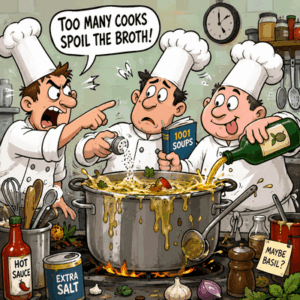
9. Too Many Cooks Spoil the Broth
When too many people get involved in a task or in the making of a decision, there is a good chance that things will go wrong. This saying uses the kitchen as an example, where having the input of too many cooks can lead to a dish being spoiled. This saying is reserved for times when people attempt to become unnecessarily involved in a situation that is already being adequately taken care of. It presents a sharp reminder that achieving the correct balance in both work and play is essential to success.
10. It Never Rains but It Pours
The last saying on our list is truly apt when considering the good old British weather. And that’s exactly where this phrase takes its inspiration from. It refers to times when things go wrong and bad luck seems to come all at once rather than in manageable chunks. When a person experiences a run of bad luck, they might say, “It never rains but it pours,” and it certainly does pour with rain a hell of a lot in Britain!
And so we come to the end of our list of Oh! So Very English Sayings, but make sure you look out for part two, because those good old English people have an endless stream of these sayings for you to learn.