 English is difficult; there’s no doubt about it. Yet just as you think you’ve mastered the difficult concepts of English grammar and punctuation, nasty little errors trip you up and make you look weak on paper. These errors become painfully obvious once they are pointed out by a smug friend or tutor, leaving you to walk away with your tail between your legs, thinking, How the hell did I miss that?
So, here’s a reminder of 12 nasty little punctuation and grammar errors that are always hiding around the next corner, waiting to spoil your hard work and make your writing look limp and feeble.
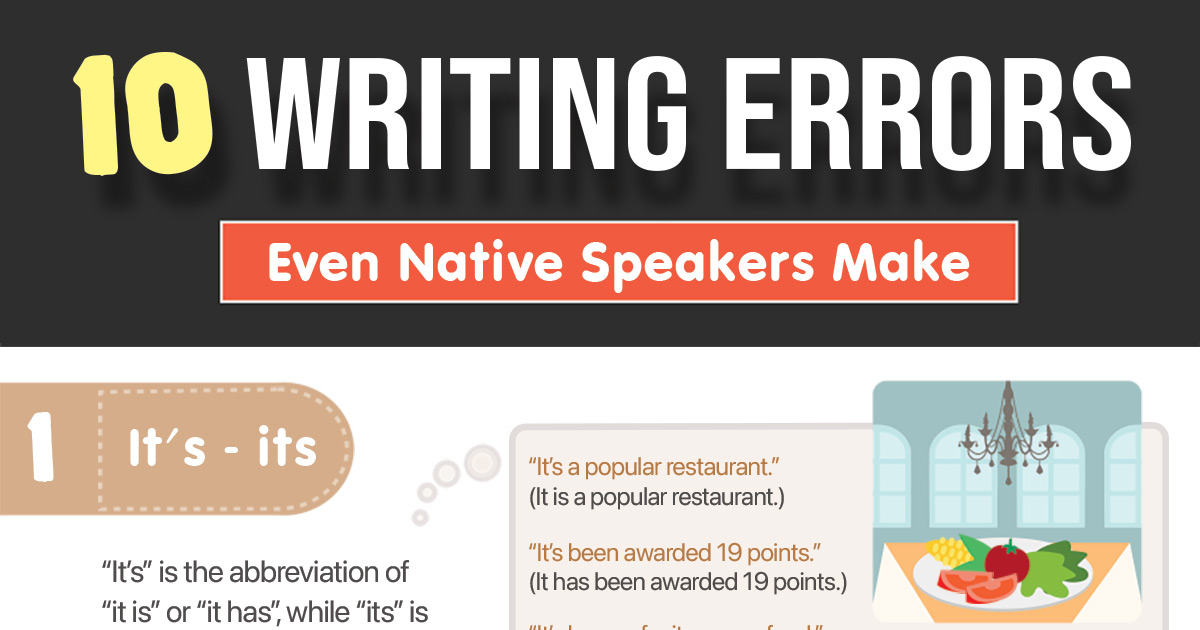
1. Its and It’s
This is perhaps the most common apostrophe mistake in the world, particularly for those new to writing English.
Its is the possessive form:
The dog had lost its collar in the park.
It’s is a short form of it is or it has:
It’s a long way to San Diego.
Remember that without the apostrophe, its implies that something belongs to someone or something. It’s is simply a contraction, or shortened version, of it is or it has.
2. Who’s and Whose
Another classic schoolboy error is the confusion of these two similar sounding words.
Who’s is a contraction of who is or who has:
I have no idea who’s going to clean up all this mess.
Whose is the possessive form of who, as in “belonging to whom”:
Whose cat is this, anyway?
3. Who and Whom
This leads us swiftly on to two more confusing words in the same category. Who and whom are often used interchangeably, purely because writers don’t know which one to use and end up taking a shot in the dark.
Who should be used as the subject of a verb:
Any participants who find themselves feeling faint should report to the medical room immediately.
Whom should be used as the object of a verb or preposition:
Anthony had, once, been a close friend whom I trusted with all my heart.
4. Fewer/Less
This is an easy mistake to make, and one that often goes unnoticed. Nevertheless, those with a solid command of written English will quickly spot this error in your work.
Use fewer with plural countable nouns:
There were fewer shades of pink.
Use less when referring to singular or uncountable nouns:
If the bill is passed, Parliament will have less power.
5. Both
This is an easy one to remember, but writers still make this mistake all the time.
Remember that both can only be used with two items.
He is both sincere and loving.
But you wouldn’t write:
He is both sincere, loving, and happy.
Easy!
6. Your and You’re
A punctuation and grammar error rolled into one, this is one that gives grammar teachers sleepless nights and makes article readers spit their coffee across the room.
Your indicates possession:
Is this your pencil?
You’re is a contraction of you are:
You’re going to the ballet tonight, aren’t you?
7. May and Might
Far too many writers use these two words interchangeably, when in fact there is a subtle difference that can alter the context of a sentence.
May is often used to suggest a stronger or more immediate possibility, whereas might can suggest a more remote or uncertain possibility.
You might score three goals on Saturday.
You may get a parking fine if you park in the wrong space.
Can you see the difference? I am far more likely to get a fine for parking in an illegal space than I am to score three goals on Saturday for my team.
8. Since and Because
Since is not always the same as because, and the two should not be used interchangeably in every situation. Since often refers to time, and because refers to causation.
Since getting this job, I’ve been working long hours because of a heavy workload.
Can you see the difference? Since refers to when I started the job, and because sets up the cause of the long work hours, which in this case is a heavy workload.
9. Anxious and Excited
Over the years, the word anxious seems to have morphed into a substitute for excited, but using it in this way can make your writing look rather confused.
Anxious means somewhat frightened, worried, or fearful. Ask any person who suffers from anxiety, and they’ll tell you they certainly don’t feel excited when they are having an anxiety attack.
I am anxious to see my dog on the weekend. (Wrong)
I am excited to see my dog on the weekend. (Correct)
Unless, of course, you have a vicious dog that frightens you.
I am anxious about going into the haunted house next door. (Correct)
10. Affect and Effect
This post wouldn’t be complete without this classic. Not a minute goes by without someone somewhere making this mistake.
Remember this: affect is nearly always a verb, and effect is nearly always a noun.
The true effects of LSD on the brain are unknown.
The effect on my health after taking LSD has been rather negative.
Taking LSD has affected my health rather negatively.
11. Farther and Further
This is another tricky one that writers tend to avoid because they simply don’t know which word is suitable. Most end up sticking with further across the board rather than making an appropriate distinction between the two.
If the distance is measurable, or referred to as such, use farther:
I kicked the football twenty yards farther today than I did yesterday.
If the distance or subject matter is immeasurable, use further:
The flooding will cause further problems in the south.
12. Envious and Jealous
That’s right. Contrary to popular belief, these two words are not one and the same, and no, you can’t substitute one for the other. To be envious, or to feel envy, is to long for what someone else has, such as their riches or luck. To be jealous, or to feel jealousy, is to fear rivalry or the loss of something you already have.
I envy his good fortune.
It makes me so jealous when my wife smiles at the milkman.
Can you see the difference? A good way to remember the difference is to think of jealousy in terms of romantic rivalry, such as one man lusting after another man’s wife, or a woman feeling jealous of her ex-boyfriend’s new girlfriend.
So there you have it. Twelve essential punctuation and grammar tips to hardwire into your memory bank and help you avoid looking weak on paper.